Table of contents
What do we really see when we look at an animal: a set of instincts, or a mirror held up to our own lives? From therapy dogs in hospitals to whales altering migration routes as oceans warm, research increasingly shows that human well-being and animal behavior are intertwined, and not only in the biological sense. Across cultures, animals have long been read as messengers, yet today that impulse is resurfacing in modern language: attention, regulation, intuition. The question is no longer whether people seek meaning in animals, but what they learn when they do.
Science keeps confirming what people feel
It is hard to dismiss the evidence now. The human body responds to animals in measurable ways, and those responses shape the story many people tell themselves afterward: “Something shifted in me.” In clinical settings, animal-assisted interventions have expanded far beyond feel-good anecdotes, and while the quality of studies varies, a consistent signal emerges. A 2019 systematic review in BMC Psychiatry examining animal-assisted therapy for mental health conditions reported overall beneficial effects on symptoms such as anxiety and depression, even as authors called for more robust trials and standardized protocols. In parallel, physiological studies have linked human-animal interaction with changes in stress markers, most famously cortisol, and with oxytocin dynamics that appear in both humans and dogs after affectionate contact, suggesting a bi-directional loop rather than a one-way “petting calms the human” story.
This is where “spiritual teacher” language quietly meets neuroscience, not because science validates metaphysics, but because it validates experience: the sense that an animal can pull a person out of rumination and back into the present moment. Attention is a muscle, and animals train it relentlessly. A cat does not negotiate your schedule, and a horse does not care about your LinkedIn persona, and that indifference can be strangely liberating. Researchers who study mindfulness often describe “non-judgmental attention to the present,” yet anyone who has tried to meditate knows how hard that is; watching an animal breathe, eat, listen, or startle can become an involuntary lesson in state-shifting, because animals move quickly between arousal and calm without the prolonged self-critique that humans tend to stack on top of stress.
There is also the social dimension, and it is not trivial. A large 2019 survey analysis published in Scientific Reports found associations between pet ownership and higher self-reported well-being, especially among people living alone; the relationship is complex and does not prove causation, but it points to a mechanism that spiritual narratives also emphasize: companionship changes perception. For some readers, the “teacher” is not mystical at all; it is the daily interruption of isolation, the demand to care for another being, and the way that responsibility reorders priorities. For others, the lesson becomes symbolic, yet the entry point remains tangible: a leash, a feeding schedule, a gaze that forces a pause.
The animal lesson is rarely comforting
Who said spiritual growth feels gentle? Animals are often cast as soothing presences, but the deeper lessons many people report are abrasive, because they confront denial. A dog that trembles at fireworks can expose how a household handles fear, and a bird that stops singing when routines change can highlight the quiet chaos humans normalize. In wildlife, the message can be even sharper. As climate change reshapes ecosystems, animals are not merely adapting; they are broadcasting disruption through their movements and survival rates. The Intergovernmental Panel on Climate Change has documented widespread shifts in species ranges, seasonal timing, and ecosystem structure, and those changes are not abstract: they show up in earlier blooms that leave pollinators mismatched, and in marine heatwaves that push fish stocks beyond familiar waters, and in mass mortality events that turn “nature” into breaking news.
In that context, treating animals as teachers is not a sentimental hobby; it can be a lens on accountability. The teacher is not the cute face on a postcard, it is the indicator species in a collapsing habitat. When salmon runs weaken, when seabirds fail to breed, when elephants traverse new routes to find water, the lesson is uncomfortable: human choices ripple outward. The spiritual vocabulary many people reach for, words like “interconnected” and “stewardship,” intersects here with conservation science, because both insist on a simple fact. Humans are not outside the system, and the “message” is carried in population data, and in satellite tracking, and in long-term monitoring that shows trends beyond what a single observer can notice.
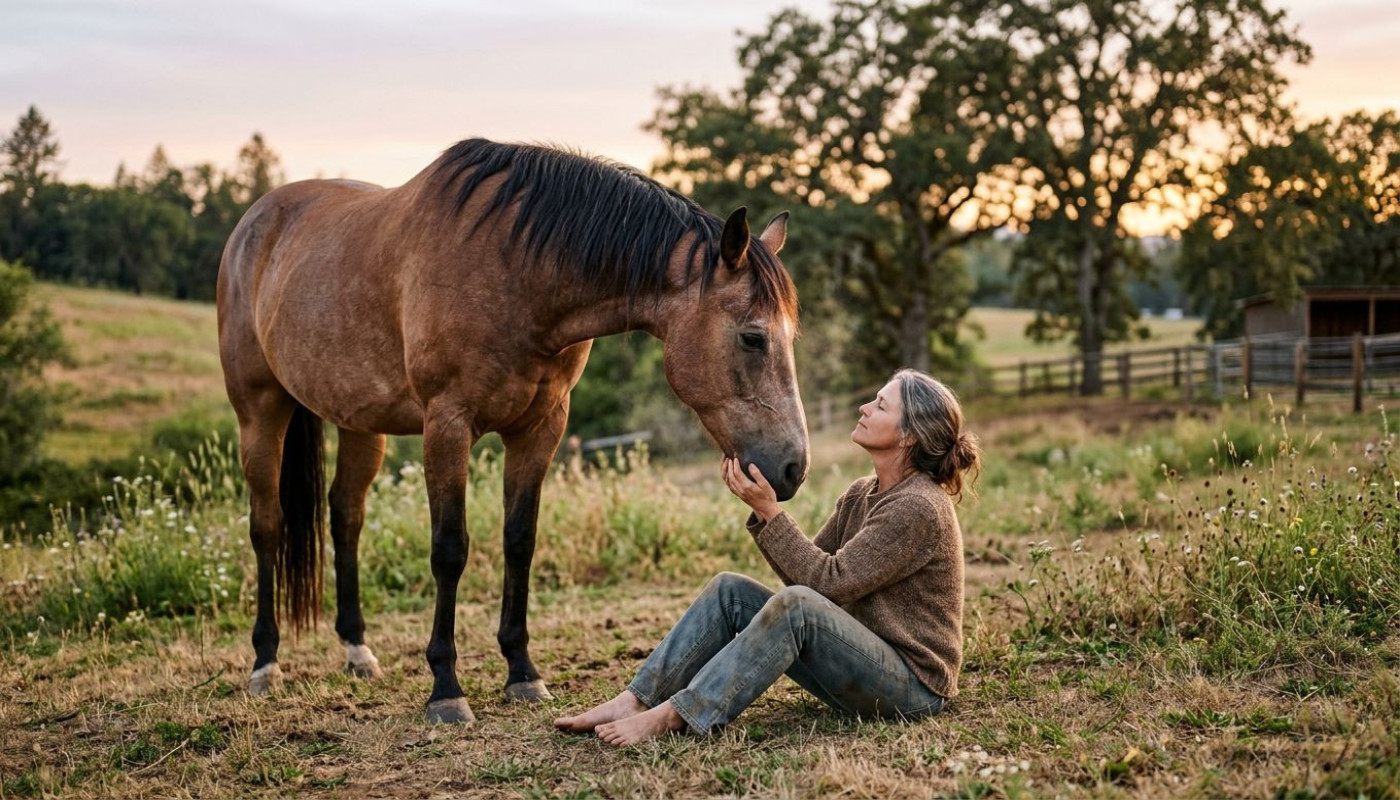
Even in domestic life, the discomfort can be personal. Animals mirror boundaries in a way friends often avoid. A horse that refuses to be led may not be “disrespectful,” it may be responding to tension in the handler’s body; many equine-assisted programs, used in therapeutic contexts including trauma-informed approaches, rely on this feedback loop. A person can talk about confidence for an hour, yet the animal responds to posture, breathing, and micro-movements in seconds. That immediacy can feel like judgment, but it is closer to consequence: a real-time demonstration that inner states leak outward, whether one intends it or not.
Intuition: the skill people practice around animals
Call it instinct, call it attunement, call it pattern recognition, but the practice looks similar. People who spend time with animals learn to read small cues, and to weigh context, and to decide quickly with incomplete information, and those are precisely the ingredients of what many describe as intuition. Importantly, intuition is not magic in the simplistic sense; psychologists often frame it as fast cognition built from experience, a way the brain compresses data into a “felt sense” when time is short. With animals, the data is constant: ear position, tail carriage, breathing rhythm, appetite changes, sleep patterns, and the subtle shift that says something is off long before a symptom becomes obvious.
That is why animals become such powerful instructors for people who want to trust their perception again, particularly after periods of stress or grief that can blunt sensitivity. The animal does not offer a lecture, it offers a stream of feedback, and the human learns to notice without catastrophizing. In practical terms, this can mean recognizing when worry is projection, and when it is a signal worth acting on; many pet owners can recall a moment they “just knew” something was wrong, and later discovered an infection, pain, or neurological issue that a routine glance would have missed. Veterinary medicine increasingly emphasizes early detection and behavioral baselines for exactly this reason: small deviations matter.
For readers drawn to the mind-body conversation, this attentiveness often expands beyond animal care into self-care. If you can notice a dog’s energy shifting after a chaotic day, can you notice your own nervous system doing the same? If you can learn the difference between a cat’s boredom and distress, can you learn the difference between your own restlessness and anxiety? Some people pursue structured study to develop this kind of perceptual literacy. Programs marketed as medical intuition training sit within a broader ecosystem of wellness education, and regardless of one’s beliefs about the sources of intuition, the appeal is clear: learning a disciplined way to listen, observe, and integrate signals without rushing to conclusions.
Traditions offer maps, but ethics matter
The idea of animals as spiritual teachers is older than modern psychology, and it spans continents. Indigenous traditions, shamanic practices, and folklore across Europe, Africa, Asia, and the Americas have long assigned animals symbolic roles, and in many communities these roles are embedded in governance, medicine, and relationship to land. Contemporary culture often repackages that inheritance into “spirit animal” language, and that is where the conversation becomes ethically charged. Cultural appropriation is not a theoretical complaint; it is what happens when sacred frameworks are reduced to aesthetic shortcuts, stripped of context, and monetized without accountability to the people who carried them through centuries of disruption and discrimination.
For readers who feel genuinely moved by animal symbolism, the more serious approach is also the more respectful one: learn where a practice comes from, and name sources accurately, and avoid claiming titles or rituals that are not yours to claim. In journalism terms, it is the difference between citing and plagiarizing, and the difference between curiosity and extraction. There is also a second ethical layer that often gets overlooked, namely the welfare of animals themselves. If an animal is a teacher, then it is not a prop, and not a tool for content, and not an accessory to a personal brand. Wildlife tourism has repeatedly demonstrated how quickly “spiritual encounters” can slide into harm, from baiting predators for photos to disturbing nesting sites, and even well-intentioned interactions can increase stress or disease transmission.
Ethics, however, does not mean disengagement. It can mean choosing observation over interference, supporting reputable sanctuaries, and treating the animal’s needs as non-negotiable. It can also mean translating reverence into policy: backing habitat protection, funding conservation science, and respecting regulations designed to keep distances safe for both humans and wildlife. In the end, the question is not only what animals teach us, but whether we are willing to learn in ways that change behavior, not just vocabulary. The most credible “spiritual” practice may be the least glamorous: consistency, restraint, and care that persists after the moment of awe fades.
Turning attention into action
To make the lesson practical, start small and schedule it: a weekly visit to a shelter, a guided nature walk with clear wildlife rules, or a regular check-in routine for a pet’s behavior and health. Budget for basics first, then training or support, and ask about local subsidies for spay-neuter, vaccinations, or adoption fees. Book reputable practitioners early; the best programs fill quickly.
Similar

3 remedies for constipation

3 ideas for maintaining your mental health
